STORY
He Called Their Bedroom Dead—Then His Wife Learned What He Had Been Pretending to Feel
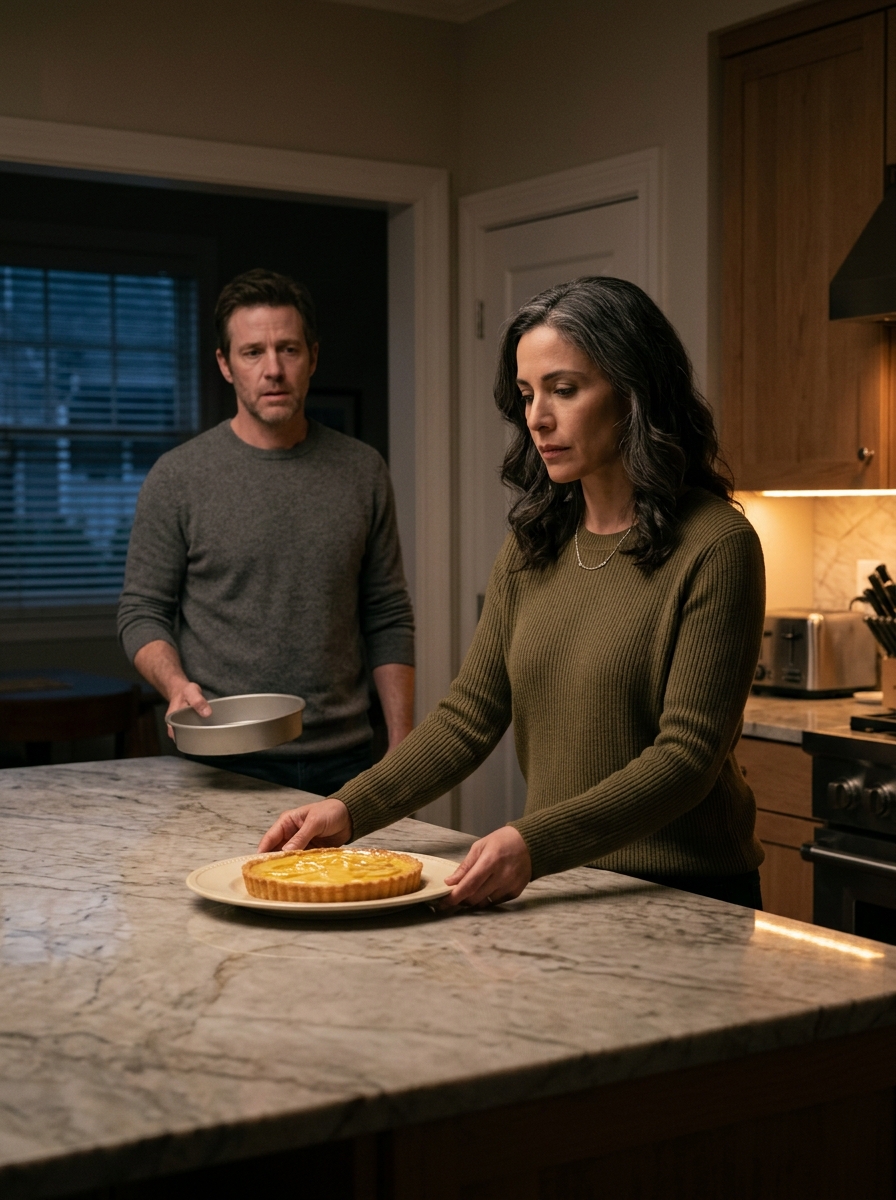
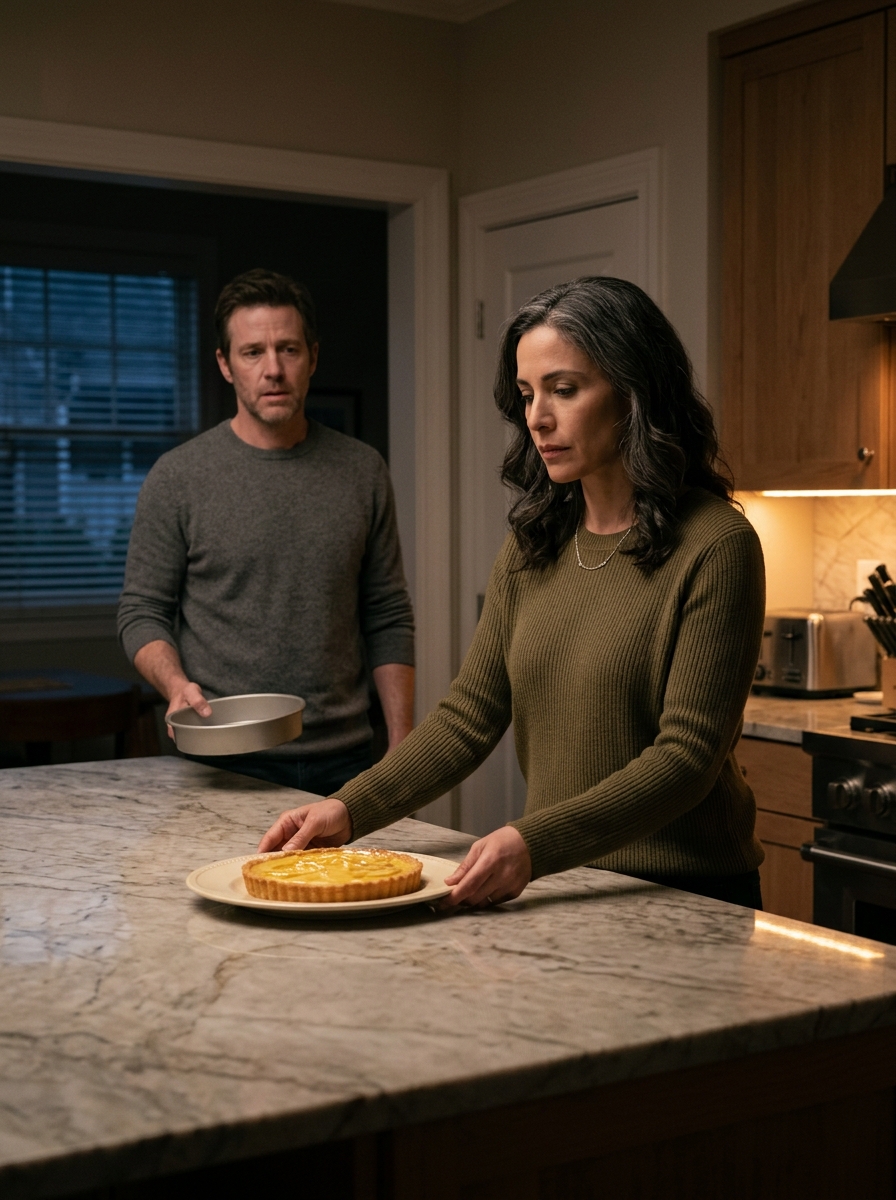
Mara Velez was carrying the lemon tart her husband had forgotten when she heard Bennett tell his best friend, “Our bedroom has been dead for two years.”
She had spent those same two years believing the death was hers.
Her body. Her face. Her failure to remain desirable after eleven years of marriage and the slow, invisible accumulation of ordinary changes. The softness at her waist. The silver beginning near her temples. The way she no longer woke up feeling like the most interesting thing in the room.
She stood outside Cal Danner’s back door with one hand under the tart plate and the other wrapped around the dish towel she had used to keep the crust from sliding.
Inside, Cal said, “You mean no sex?”
Mara stopped breathing.
Bennett gave a short, exhausted laugh. “I mean the whole thing. I keep waiting for wanting to come back, like it got lost somewhere. It didn’t.”
The kitchen window was open over the sink. She could hear the dishwasher humming, the clink of ice in a glass, the low drone of traffic beyond Cal’s fence.
Cal said, “Have you told her?”
“No.”
“Bennett.”
“I know.”
“You can’t keep calling something dead and then act like it’s weather.”
“I know.”
Mara should have stepped inside. She should have dropped the tart, thrown open the door, demanded that her husband look at her while he explained what he had said.
Instead, she listened.
“It isn’t because she doesn’t love me,” Bennett said. “That’s the part I can’t explain.”
“What part?”
“I don’t know if I’ve ever wanted sex the way I thought I was supposed to. I think I may be asexual. Or somewhere close to it. I just know I’ve spent eleven years pretending uncertainty was the same thing as desire.”
The tart grew heavy in Mara’s hands.
She set it on the porch rail and walked home.
***
Bennett found her in the kitchen forty-two minutes later.
He had brought the empty ceramic plate back from Cal’s, along with two glasses of wine he had apparently collected on the way out. He placed the glasses on the counter and looked at Mara.
The lemon tart sat between them, untouched.
“What happened?” he asked.
Mara folded the dish towel into a square. Then she unfolded it and folded it again.
“Tell me which part of our bedroom you’ve been calling dead.”
Bennett stopped in the doorway.
The expression that moved across his face was not guilt exactly. It was recognition. He knew the secret had arrived before he had.
“Where did you hear that?”
“Answer me.”
He looked toward the living room, as if Cal might still be sitting there with a hand on his shoulder. “Mara—”
“Was it our sex life? Was that what you told him?”
“No.”
“Then what was it?”
He took a breath.
“The part of me that has been pretending it knows how to want.”
She laughed once. There was nothing funny in it. “You told Cal before you told me.”
“I was practicing.”
“You practiced my marriage on your friend?”
“I was trying to say it somewhere before I said it to you.”
“For two years?”
His silence answered her.
Mara pressed both palms flat against the counter. “I need you to understand that I have been living inside an explanation you never gave me.”
“I know.”
“No, you don’t. You think this is about whether you want sex. It isn’t only that. It’s that I spent two years trying to figure out what I had done to make you stop wanting me.”
“I never stopped wanting you.”
“Don’t say that like it clears anything.”
Bennett’s mouth tightened. “I know how it sounds.”
“It sounds like you want me to be comforted by a sentence that means whatever you need it to mean.”
He looked at her then. His eyes were red-rimmed, and Mara hated that she noticed. She hated that tenderness still arrived on schedule, even when she wanted anger to be easier.
“I think I might be asexual,” he said. “Or somewhere on that spectrum. I don’t know if the word is exactly right. I don’t know if there’s a better word. I only know that it’s the first possibility that hasn’t made me feel defective.”
Mara stared at him.
She had expected an affair. Another woman. A private resentment. Maybe the blunt cruelty of discovering that he had stayed married out of habit.
She had not expected a word she had encountered online and never connected to him.
“Asexual,” she repeated.
“Yes.”
“And you decided that two years ago?”
“No. Two years ago, I decided something was wrong with me. The word came later.”
“What happened two years ago?”
Bennett pulled out a chair but didn’t sit. “You asked me if I still wanted you.”
“I did.”
“You asked me three times.”
“Because you wouldn’t answer.”
“I did answer.”
“You said, ‘Of course I do,’ while looking at the wall.”
His face changed.
Mara remembered that night with painful clarity. She had worn a blue shirt she rarely wore because the fabric made her feel elegant. They had been in a hotel after her museum’s annual fundraiser. Bennett had spent the evening touching the small of her back, kissing her forehead, telling her how beautiful she looked. Then, in the room, something had gone quiet between them.
She had asked what was wrong.
He had said he was tired.
She had asked if he was attracted to her.
He had said, “Of course.”
She had asked again because the answer had sounded like a courtesy.
Now he said, “I was afraid that if I told you I didn’t know what I felt, you would hear that I didn’t love you.”
“And did you know what you felt?”
“I knew I loved you. I knew I wanted to be close to you. I knew I wanted the evening to go well. I knew you were beautiful. I didn’t know if I wanted sex, or if I wanted you to feel wanted, or if I wanted to be the kind of husband who wanted it.”
Mara shook her head. “You had eleven years to figure out the difference.”
“I know.”
“You keep saying that.”
“Because there isn’t a defense.”
She looked at the wine glasses. “Did you ever want me?”
“Yes.”
The answer came so quickly that it almost hurt more.
“Sexually?”
Bennett swallowed. “Sometimes I wanted pieces of what people call sexual desire. Sometimes I wanted kissing, or closeness, or the feeling of being chosen. Sometimes my body responded to something, but that wasn’t the same as wanting. I didn’t know that distinction existed.”
Mara’s voice dropped. “So what was our marriage?”
His eyes filled, but he didn’t look away.
“Real,” he said. “It was real. I loved you. I love you. I wasn’t pretending to love you.”
“But you were pretending to want me.”
“I was pretending I understood my own wanting.”
“That is not better.”
“No.”
She turned away from him. On the refrigerator, beneath a magnet shaped like a tiny yellow house, was a photograph from their first summer together. Bennett was twenty-eight and sunburned. Mara was twenty-six and laughing at something outside the frame. They looked young enough to believe that honesty was something people naturally possessed.

More From This Author