STORY
My Son Asked If I Was Alone—Then My Dead Wife’s Tablet Spoke
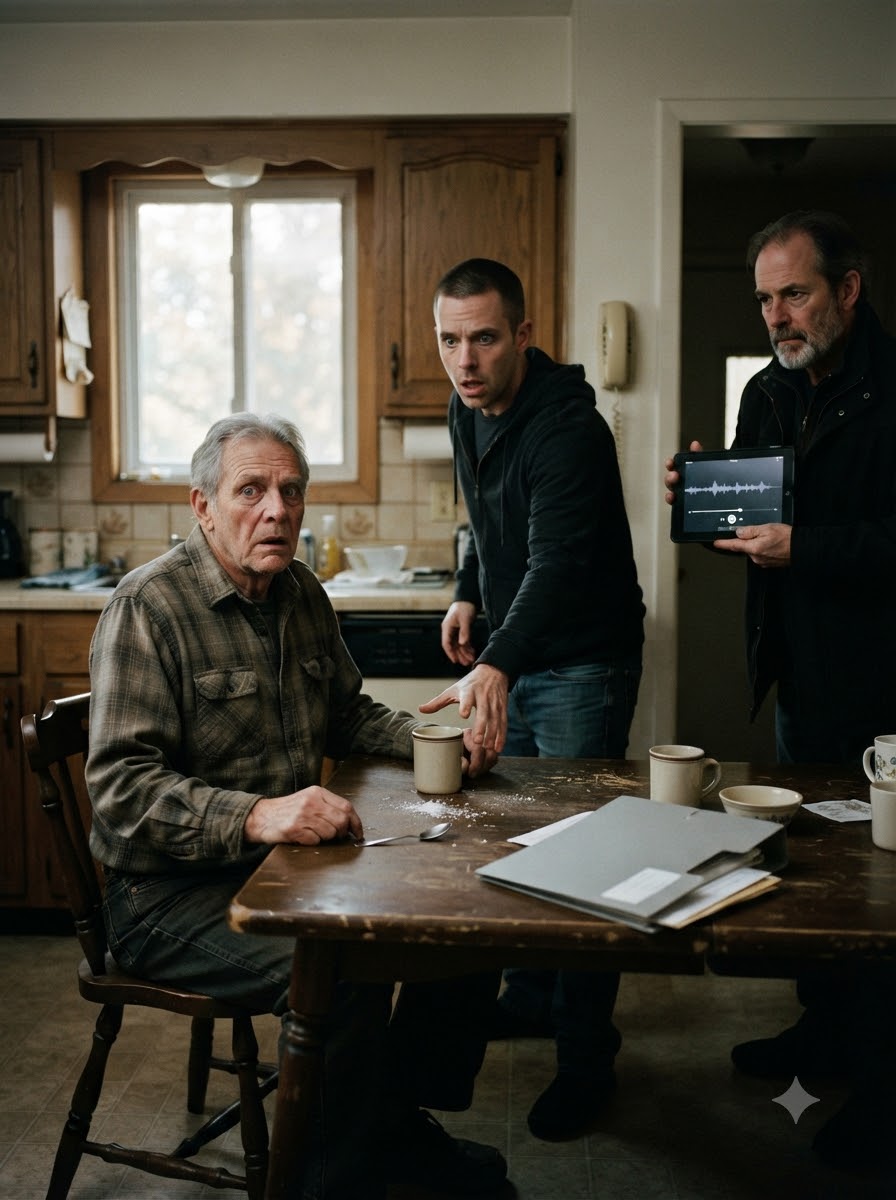
By the time my son realized I was not alone, he had already poured the drugged coffee into my cup.
Daniel stood at my kitchen counter with the silver thermos tilted in one hand. His other hand rested beside a plastic pharmacy bag he had tried to slide behind the toaster.
Morning light fell across the linoleum. Carol’s blue hydrangeas moved gently outside the window.
Everything looked ordinary except my son’s face.
“Who’s here?” he asked.
He had heard the floorboard complain in the hallway.
I watched his eyes move toward the doorway, then toward the back door, measuring distance.
“Morning, Danny,” Frank said behind him.
Daniel jerked so hard that coffee splashed across the counter.
Frank Bell filled the kitchen doorway in his stocking feet, holding his phone chest-high. Its camera had been recording since Daniel came through my back door without knocking.
My son stared at him.
Then he looked at me.
“You said you were alone.”
Those were the first honest words spoken in my house that morning.
Daniel set down the thermos.
“What is this?” he demanded. “Some kind of ambush?”
I kept both hands flat on the table because they had started trembling.
“No,” I said. “This is the first Sunday in eighteen months when your ambush didn’t work.”
His face changed.
Only slightly. A tightening beside his mouth. A hardening behind the eyes.
But I saw it.
The person standing in my kitchen was not the little boy who used to crawl into our bed during thunderstorms. He was not the teenager Carol had waited up for, porch light burning. He was not even the grieving son who had held me at his mother’s funeral.
He was a cornered man.
And cornered men are dangerous.
Every Sunday at exactly seven, Daniel called me.
“Dad, are you alone?”
For eighteen months, I had told him the truth.
Last Sunday, I lied.
Six days earlier, Frank and I had been sitting on my back porch, drinking root beer and watching rain darken the fence.
He had stayed with me that weekend after driving down from Grants Pass. Frank and I had worked together at the Oregon Department of Transportation for almost fifteen years. He could spot a failing retaining wall from fifty yards and a liar before the liar finished his sentence.
The next morning, my phone rang at seven.
Daniel asked about my blood pressure pill, my sleep, and whether anyone had visited.
Then came his usual question.
“Are you alone?”
I looked through the kitchen doorway at Frank, who was sitting on the edge of the spare bed pulling on his knee brace.
“No,” I said. “Frank’s here.”
There was a pause.
Not long. Maybe two seconds.
“Oh,” Daniel said. “Still?”
Something about that word made Frank lift his head.
“Until after lunch,” I said.
Daniel ended the call quickly. He said he had errands and would call later.
He didn’t.
Frank came into the kitchen.
“He always asks that?”
“Every Sunday.”
“And when you say yes?”
“He says good.”
Frank frowned.
“Good because you’re safe, or good because nobody can see what happens next?”
I laughed at him.
At least, I tried.
But memory had already opened a door.
For months, odd things had happened after those calls.
Daniel would sometimes appear with groceries I had not requested. He would refill my pill organizer even after I told him I could manage. Once, he brought papers from what he called a senior tax-relief program and marked the places where I should sign.
Another Sunday, he took photographs of my driver’s license and Social Security card. He said my bank needed updated identification.
After Carol died, paperwork frightened me in a way it never had before. She had handled insurance, taxes, and household accounts. Daniel seemed eager to help.
I had mistaken eagerness for devotion.
Frank asked to see the papers I had signed.
I kept documents in Carol’s old sewing cabinet, tucked into labeled folders in her careful handwriting. We found property tax statements, insurance notices, and bank records.
We did not find the senior tax-relief forms.
Frank opened my laptop and pulled up the county property records.
There, beneath my name, was a document filed eleven months earlier.
A home equity line of credit for $187,000.
I stared at the number until it stopped looking like money.
The lender was a private finance company in Portland. The application had been signed electronically. Attached to it was a durable power of attorney naming Daniel Whitaker as my agent.
My signature appeared at the bottom.
It looked almost right.
That was the frightening part.
Carol used to joke that my handwriting resembled a seismograph during an earthquake. Daniel had copied the shape, the tilt, even the ridiculous loop in my H.
But I had never signed that document.
We called the lender from Frank’s phone.
After transfers and identity questions, a woman named Ms. Alvarez told us the credit line had been nearly exhausted.
One hundred seventy-two thousand dollars had been withdrawn.
The money had gone to a company called Cedar Path Senior Services.
I had never heard of it.
Frank searched the Oregon business registry. Cedar Path had been formed fourteen months earlier by Melissa Crane.
Melissa was Daniel’s girlfriend.
She had come to Christmas dinner wearing white cashmere and carrying a bottle of wine expensive enough to make me uncomfortable. She worked as a medical assistant at an urgent care clinic in Ashland. Daniel had said she was helping him start a property-management business.
We printed everything.
Then Frank insisted we check my credit report.
There was a credit card I did not recognize, a personal loan, and an application for long-term care benefits made in my name. The mailing address for two accounts was Daniel’s apartment.
But the worst discovery came from my life insurance company.
Daniel had contacted them three times in four months.
He had asked how quickly a claim would be processed after an accidental death.
The representative had recorded the calls.
I was quiet for a long time.
Frank sat across from me, his jaw clenched.
Finally, I said, “He’s in debt. That’s all. He panicked.”
Even then, I tried to rescue my son from the truth.
Frank did not argue.
He simply asked when I had last checked my medication.
My blood pressure tablets came in a white bottle. They were small, pale yellow, and scored down the middle.
The pills in my Sunday organizer were white.
I felt cold despite the heater running.
We took the organizer and bottle to my pharmacy. The pharmacist, a woman named Erin who had known Carol, examined them in the consultation room.
The white tablets were not mine.
They were a strong prescription sedative.
“Have you been dizzy?” she asked.
I remembered waking on the bathroom floor three months earlier with a bruise along my temple. Daniel had found me after I failed to answer his second Sunday call. He had insisted age was catching up with me.
I remembered falling on the porch steps.
I remembered mornings lost to fog.
Erin sealed the tablets in a bag and told us to call the police.
Detective Lena Ortiz listened without interrupting.

More From This Author