STORY
My Son Asked If I Was Alone—Then My Dead Wife’s Tablet Spoke
She did not dismiss me as confused or lonely. She took the forged power of attorney, account records, insurance notes, and pills. She asked who had access to my house.
Daniel had a key.
So did Patrice, my neighbor across the street.
Patrice had given hers back after Carol’s funeral. Daniel never had.
Ortiz requested bank surveillance and account records. By Thursday, she had video of Daniel making two withdrawals using the forged document. She also obtained footage from a pharmacy in Ashland showing Melissa buying syringes and glucose-testing supplies.
That did not prove murder.
Melissa worked in medicine. Syringes were legal. Sedatives could be explained away.
Then Patrice remembered her doorbell camera.
Her camera caught part of my driveway. Going through months of recordings, we found Daniel arriving on eleven Sunday mornings, always within forty minutes of asking whether I was alone.
On three of those Sundays, he carried a pharmacy bag.
Once, he left with my medication bottle.
Detective Ortiz believed Daniel and Melissa were preparing to make my death look natural or accidental. A widower. Sixty-three. High blood pressure. Recent falls. Sedatives in his system.
The home equity fraud would disappear into probate confusion. The life insurance would pay Daniel enough to cover the stolen money and whatever other debts he had accumulated.
But Ortiz wanted them in the act.
I wanted to change the locks and never see my son again.
Instead, I agreed to answer the next Sunday call.
Frank’s truck remained in Patrice’s garage Saturday night. He slept in my spare room with the curtains closed. Ortiz placed officers two houses away and gave Frank instructions to record only if it was safe.
At exactly seven, my phone rang.
“Morning, Dad,” Daniel said.
His voice was warm.
Familiar.
For one weak second, I wanted the whole thing to be a misunderstanding.
He asked whether I had taken my pill.
“Not yet.”
“Did you sleep okay?”
“Pretty well.”
“Anyone there?”
I looked at Frank.
“No,” I said. “Just me.”
Daniel exhaled.
“Good. Okay, good.”
He arrived twenty-three minutes later carrying cinnamon rolls, the thermos, and a pharmacy bag.
He let himself in.
“I thought I’d surprise you,” he said.
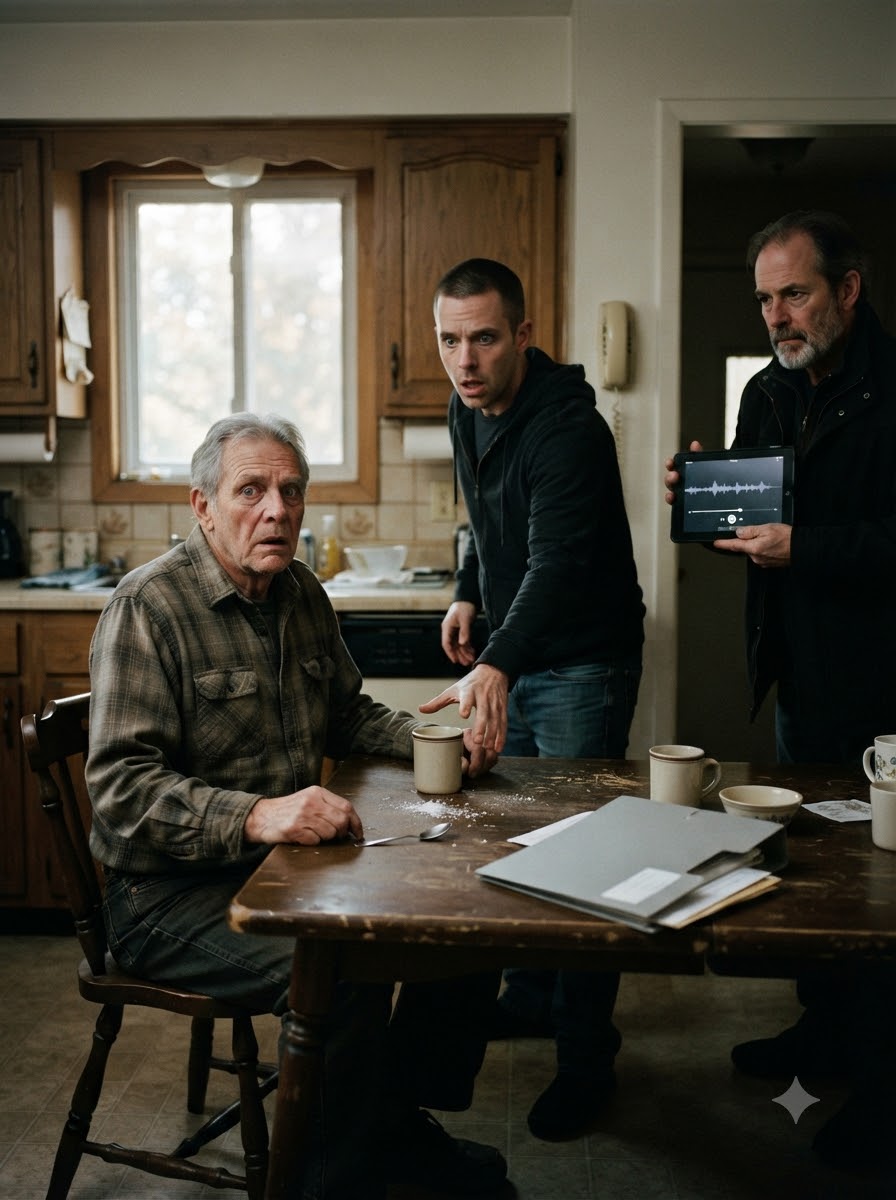
He poured coffee before I could stand. He placed the cup near my right hand and watched me.
“Aren’t you having any?” I asked.
“I already did.”
He smiled, but his attention stayed on my cup.
I lifted it once, pretending to test the heat. I did not drink.
That was when Frank stepped into the doorway.
Now Daniel stood trapped between us, calculating.
“What’s in the coffee?” I asked.
“Coffee.”
“Then drink it.”
His laugh was sharp.
“You’re being ridiculous.”
He reached for the cup, but not to drink. He knocked it sideways.
Coffee spread across the table and dripped onto the floor.
Frank moved forward. Daniel shoved him hard enough to slam his injured knee into a chair.
Then Daniel grabbed the pharmacy bag.
I caught his wrist.
He was stronger than I remembered. For a moment we struggled beside the counter, father and son, our faces inches apart.
“Let go,” he hissed.
The bag tore.
A capped syringe fell onto the linoleum.
Daniel froze.
The back door opened.
Detective Ortiz entered with two officers.
Daniel immediately raised his hands.
“This isn’t what it looks like.”
Ortiz ordered him away from the syringe.
“It’s Melissa’s,” he said. “She’s prediabetic. I must’ve grabbed her bag.”
“Then why did you try to destroy the coffee?” Frank asked.
“I spilled it because my father is confused and you’re winding him up.”
He turned to me with tears suddenly shining in his eyes.
“Dad, you know me. You’ve been forgetting things since Mom died. You signed those papers. You asked me to help.”
It was almost convincing.
That was Daniel’s first defense: deny.
His second was blame.
He told the police Frank wanted my house. He said Patrice was senile. He claimed the lender had explained every document to me. He said the sedatives were Carol’s old medication and I must have mixed them up.
Then Ortiz showed him a photocopy of the forged power of attorney.
Daniel’s face remained still.
She showed him photographs from the bank.
His breathing changed.
She told him the coffee would be tested, as would the syringe.
He looked toward the door.
And then Melissa arrived.
She pulled into my driveway in her gray SUV, apparently expecting Daniel to text when it was finished. An officer stopped her before she reached the porch.
Inside her vehicle, police found disposable gloves, alcohol wipes, a blood glucose meter, and an empty vial of fast-acting insulin taken from the clinic where she worked.
The second layer of their plan came apart by lunchtime.
The coffee contained enough sedative to leave me unconscious.
The syringe contained insulin.
I was not diabetic.
According to prosecutors, Daniel intended to drug me, inject the insulin, then wait while my blood sugar fell. He would call 911 later and report finding me unresponsive during one of his loving Sunday visits.
My recent falls and medication confusion would support the story of an old man declining after his wife’s death.
Melissa eventually confessed.
She said Daniel owed more than $240,000 from online sports betting, private loans, and a failed cryptocurrency scheme. He had told her I had promised him the house and was “taking too long to die.”
She claimed the fraud had been his idea.
He claimed the medical plan had been hers.
They turned on each other so completely that there was almost nothing left for a jury to do.
Daniel pleaded guilty before trial to attempted aggravated murder, identity theft, first-degree forgery, attempted theft by deception, and financial abuse of a vulnerable person.
Melissa pleaded guilty to conspiracy, theft, unlawful possession of controlled substances, and tampering with medical records.
Daniel was sentenced to twenty-three years in prison.
Melissa received nine.
The court voided the forged power of attorney and home equity agreement. The lender fought at first, but bank footage, signature analysis, and its own failure to verify my consent left it little room. Its insurer restored the stolen equity and paid my legal expenses.
The remaining money in Cedar Path’s accounts was seized.
Daniel’s truck, Melissa’s SUV, and several expensive watches bought with my money were sold toward restitution.
I changed my will.
That was harder than testifying.
I removed Daniel as beneficiary and executor. Most of what I have will now go to a scholarship for children of road workers killed on the job. The house, if it is still mine when I die, will be sold to support a local grief center.
I kept one box for Daniel.
It contains his childhood photographs, school awards, and the red plastic dinosaur he carried everywhere when he was four. Someday, if prison authorities allow it, I may send it.
Not as forgiveness.
Not yet.
As evidence that he was loved before he decided love was something to rob.
For a while, Sundays were unbearable.
At seven, I would sit in the kitchen and stare at the silent phone. I missed the call even though I knew what it had meant. Betrayal does not erase affection cleanly. It leaves it behind like a phantom limb, aching where something poisonous used to be.

More From This Author