STORY
Uncle Jesse Opened My Father’s Hidden Box—Then the Family Lie Began Playing
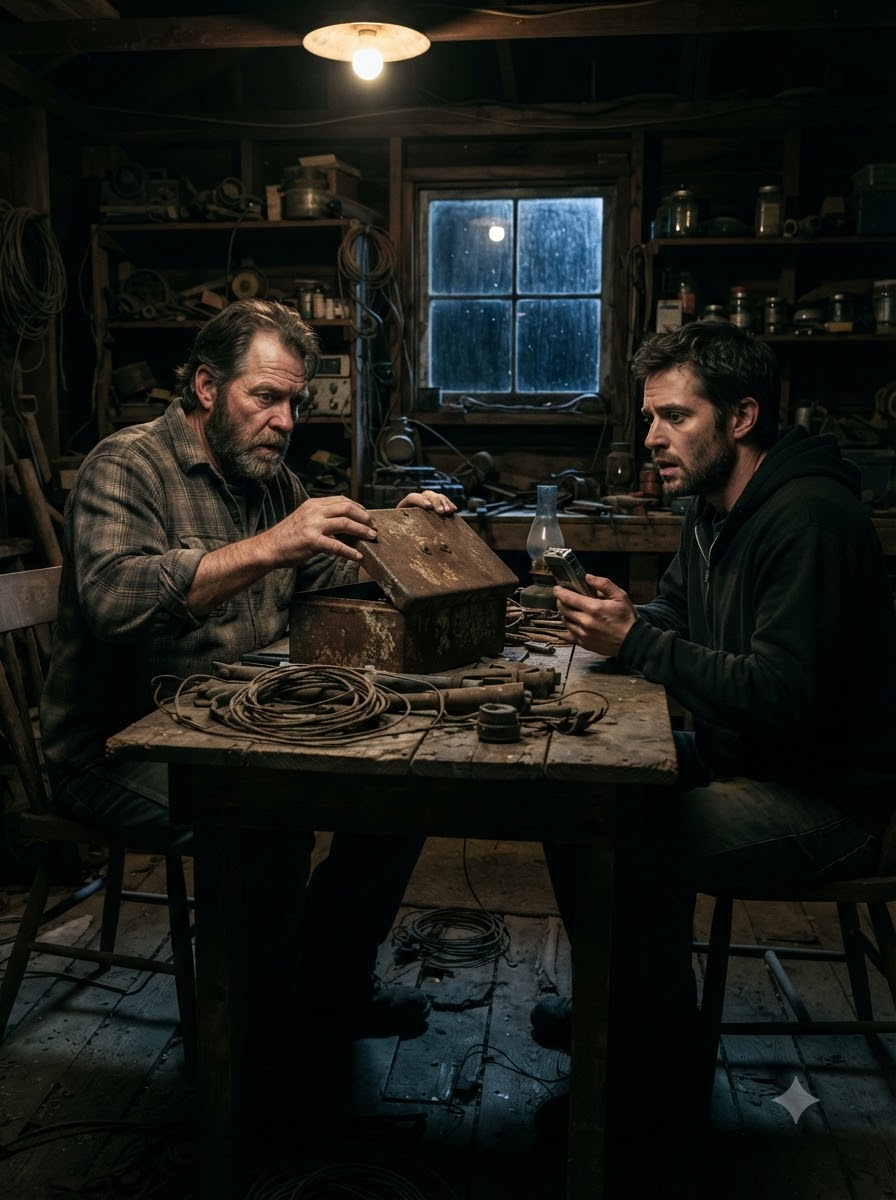
“I had no idea we owned land,” I said.
“Neither did I, until I came home.”
The deed in the tin named my father as the sole owner. Jesse had found the drawing months earlier and worked out that it marked the old deed, but the first hole he dug had turned up nothing. Yesterday, while replacing the garden marker after a storm, he found a second measurement written on its back. My father had drawn from the fence as it stood twenty years ago. Jesse had rebuilt that fence a foot farther in.
I read the letter again. It proved my father had worried about Elaine, but it did not tell us where the land had gone or how a lien had appeared on our house.
Jesse reached into his jacket. “This does.”
He set an envelope beside the tin. Inside were copies of county records and a page of notes in his careful handwriting. He had visited the recorder’s office the previous week after finding the deed information in my father’s drawing. According to the public record, my father had signed the land over to Elaine’s trust six months after his death.
For a moment I thought I had misread the date.
“Maybe it was filed late,” I said.
“Look at the signature date.”
It was dated that same day, six months after we had buried him. A notary’s stamp sat beneath his name. Jesse had also found a lease recorded the following year, granting a gravel company access to the property. It directed payments to Elaine’s trust.
My hands went cold. I pictured my mother coming home exhausted from cleaning offices while someone collected money on land my father had meant to leave her.
The second page in Jesse’s envelope was a printout from the county clerk’s office. The notary on the deed was Elaine’s friend Martin Voss, a man who had handled paperwork for several family members. Jesse had called him that afternoon. Martin had agreed to meet us the next morning, though he would not say why.
“Why didn’t you tell me when you found the record?” I asked.
“Because Elaine’s name is on everything. I needed someone who could tell us what she did, not just what I think she did.” He glanced toward the stairs. “And I didn’t want Ruth hearing an accusation I couldn’t yet prove.”
I wanted to be furious with him for waiting. Instead I looked at my father’s letter, creased where his fingers had folded it. He had hidden it under a fence line so my mother would have it if she ever needed it. For years, none of us had known where to look.
The next morning, I arranged for a neighbor to sit with my mother. Jesse and I met Martin Voss in the parking lot of a diner two towns over. He was old, with a walking stick and a brown envelope tucked under his arm.
He did not shake Jesse’s hand.
“I should have come forward when Sam died,” he said. “Elaine told me the transfer had been signed before the accident. She asked me to stamp it afterward. I knew I shouldn’t.”
“Sam never signed it,” Jesse said.
Martin stared at the pavement. “I know that now. I watched Elaine copy his name from a Christmas card. I told myself she was protecting the family.”
He handed me the envelope. It held a copy of his notary journal. The entry for my father’s transfer had been squeezed between two others in different ink. Martin had kept the journal when he retired because Elaine had later asked him to destroy it. He had also kept a letter she sent him, promising that the land transfer would “settle what Sam owed the family.”
“Did he owe her anything?” I asked.
“Not that I knew of.”
Then Martin looked at Jesse. “I told the police you started the fight.”
Jesse’s jaw tightened. “I threw the punch.”
“You came to ask me about the deed. Elaine was there. She said Sam had left Ruth with debts and you were trying to take what little she’d recovered. I called you a thief. You hit me. When I fell, I struck my head on the bar.”
For years I had pictured that fight as a senseless drunken eruption. Jesse had been drinking, and he had hurt Martin badly. But he had gone there because he suspected Elaine was stealing from us. He had gone to prison before he could prove it.
Martin rubbed a hand over his face. “I remembered more when I got home. About the signature. I should have told someone. I was ashamed, and I was afraid she’d say I’d forged the whole thing alone.”
We took the documents to a legal-aid attorney Jesse had contacted, a woman named Priya Shah. She read every page while we sat across from her desk. She said the original deed and my father’s letter mattered, but Martin’s testimony and journal were stronger. She warned us not to confront Elaine yet.
“There’s the house lien too,” I said.
Priya obtained a copy that afternoon. It had been recorded only three weeks earlier, though it claimed my mother had signed it fifteen years ago. The notary listed on it was not Martin. When Priya called her, the woman said she had never seen the document. Her stamp had gone missing from her office the previous month, and she had reported it to the police.
Priya put down the phone. “Now we go to them.”
I wanted to tell my mother first. She was sitting up in bed when I got home, holding a mug of tea in both hands. She listened without interrupting as I showed her my father’s letter. When she reached the line about Elaine, she lowered the page.
“Elaine came here after the funeral,” she said. “She told me Sam had been borrowing from the family. I asked her for the papers, and she said I was too upset to understand them.” My mother looked toward the window. “I believed her long enough to feel ashamed. Then I decided we would manage whatever we owed. She never brought it up again.”
“She never had proof,” I said.
My mother touched the edge of my father’s handwriting. “Sam should have told me he was frightened of her.”
“Maybe he meant to.”
That afternoon, Elaine called. She offered ten thousand dollars less than Mr. Price’s first figure and said she needed an answer by Friday. I put her on speakerphone while Priya listened from her office.
I told Elaine I had found records for the gravel land.
There was a pause. Then she laughed. “Jesse’s been filling your head with stories.”
“I have Dad’s deed.”
“He gave me that land.”
“After he died?”
“I don’t know what you think you’ve read.”
“I read the date.”
Her voice sharpened. “Your mother couldn’t keep a roof over your head without help. Sam knew that. I took care of what he left behind.”
Priya wrote something on a pad and slid it toward me: Ask about lien.
I asked why she had recorded a debt against our house only after my mother became ill.

More From This Author