STORY
He Told His Best Friend Their Bedroom Was Dead—But His Reason for Stopping Wasn’t What His Wife Expected
The sentence did not sound like a complaint so much as a verdict.
“Our bedroom has been dead for two years.”
Nora heard it through the open side door while carrying a paper bag of noodles and two cans of sparkling water. She had come home early from the museum because the oral-history interview she was editing had been canceled. At thirty-eight, Nora had developed the habit of noticing voices before words—the pitch of them, the pressure underneath, the small changes that told her whether someone was trying to sound calm.
Owen’s voice had no pressure in it at all.
That was what made her stop.
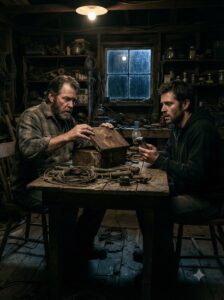
Rafi was in the garage with him, sitting on an overturned paint bucket while Owen sanded the edge of an old walnut tabletop. The garage light shone over their shoulders. Rafi had been Owen’s closest friend since college, the person who knew where the spare key was and which jokes Owen used when he was frightened.
“Does Nora know?” Rafi asked.
There was a pause.
“She knows it stopped,” Owen said. “I don’t know if she knows I made a decision about it.”
Nora stood very still.
The paper bag warmed her palm. Somewhere down the block, a child called for a dog. The normality of the sound made the sentence feel even more violent.
She backed away from the door, crossed the yard, and went inside through the front. She put the food on the counter. She took off her coat. She even washed her hands, because she had no idea what else a person did after learning that the most private part of her marriage had become a subject in someone else’s garage.
For forty minutes, she sat at the kitchen table and listened to the house.
The dishwasher ran. The heat clicked on. A car passed outside.
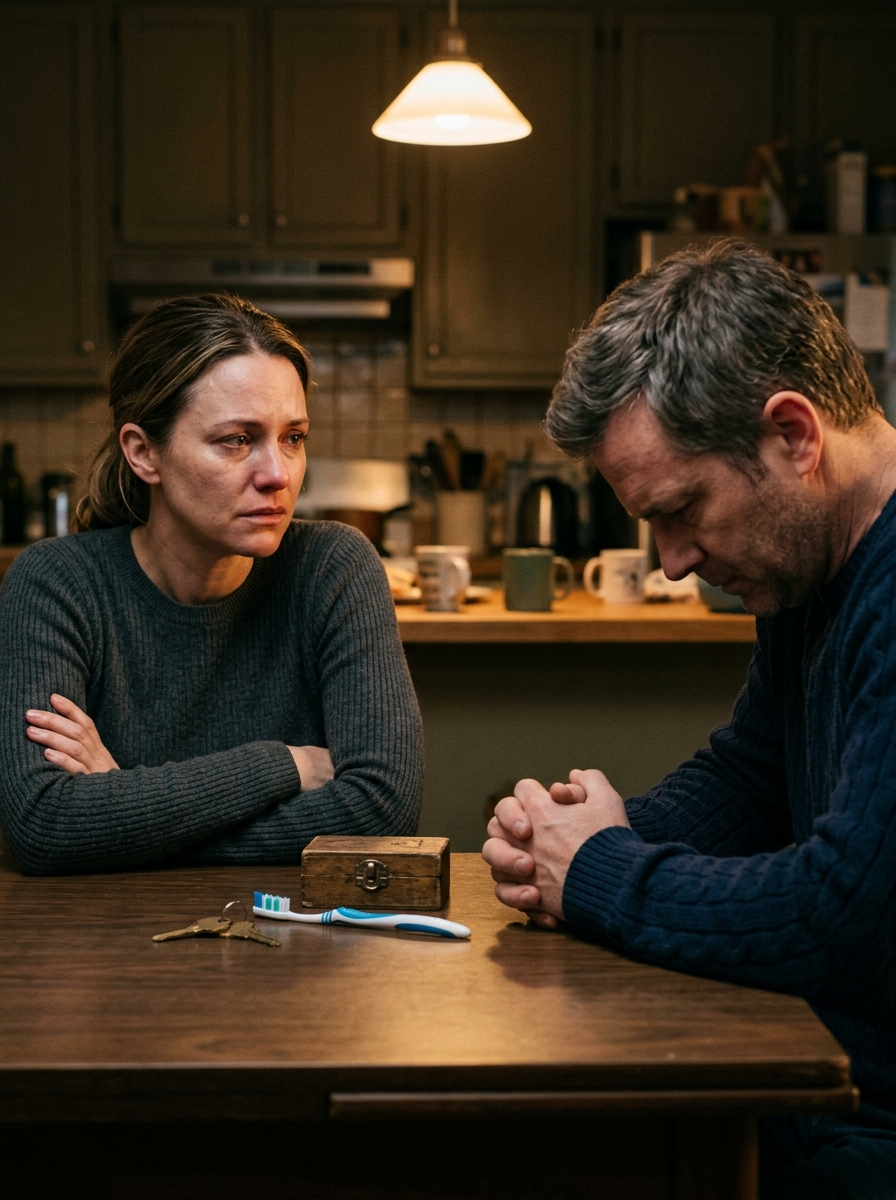
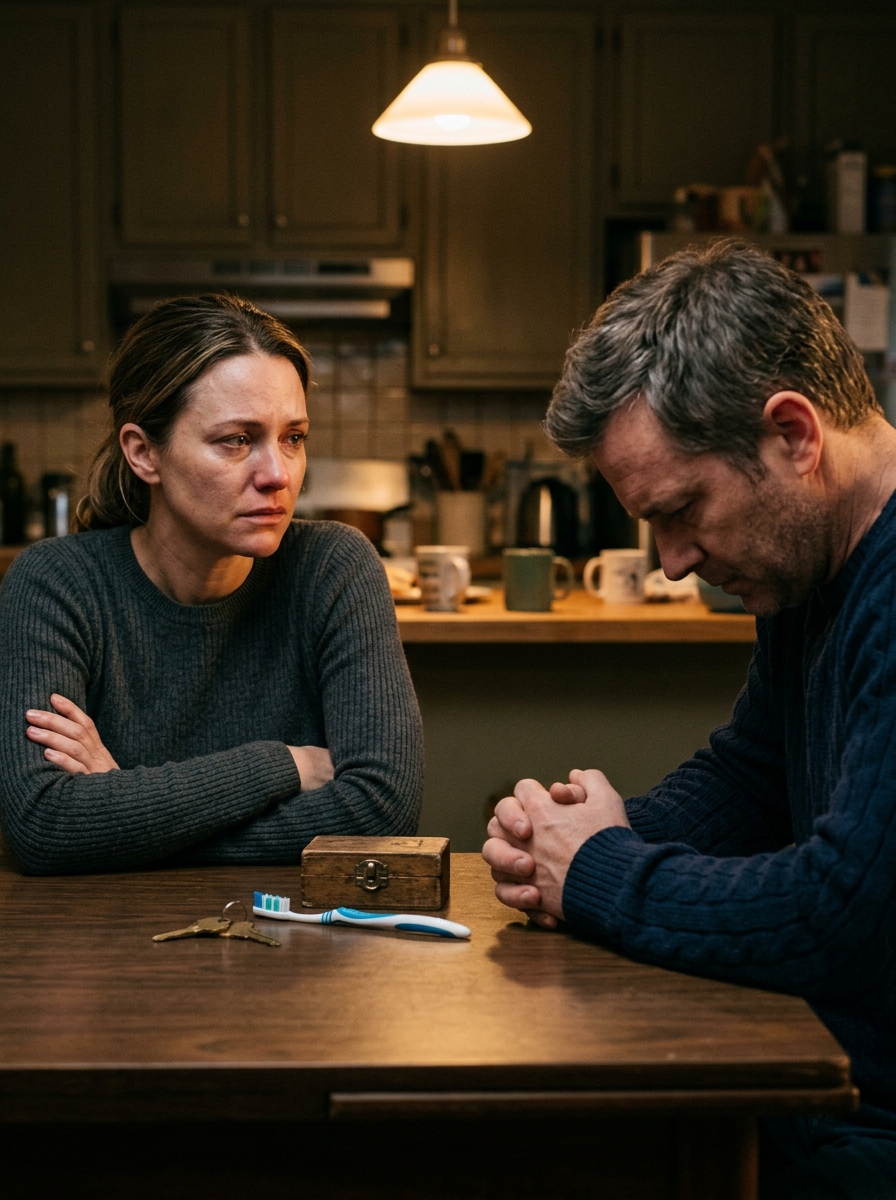
When Owen finally came upstairs, his hair was dusted with pale wood shavings. He saw her at once. He saw the spare key, the toothbrush, and the little wooden box on the table.
His expression changed.
“You heard us.”
“Which part was I supposed to hear?” Nora asked. “The bedroom, or the fact that you’ve been discussing it with Rafi?”
Owen closed the door behind him.
“Nora—”
“Do you want to leave?”
“No.”
“Do you want me to leave?”
“No.”
“Then why did you say it like I was a body you’d been keeping in the house?”
He glanced at the objects on the table. The key was the one he used for the workshop. The toothbrush was new, still sealed in plastic. The box held their marriage certificate, passports, and the deed to the house.
“I didn’t say our marriage was dead.”
“You said our bedroom was dead.”
“That’s different.”
“Why?”
“Because the bedroom is a room.”
She gave him a flat look.
Owen rubbed both hands over his face. He was forty-one, broad-shouldered, with the patient hands of a man who could repair a chair without making the damage visible. He had always been good at objects. He understood the grain of wood, the weakness in an old joint, the exact amount of pressure needed before something cracked.
With Nora, he had learned to be careful.
Too careful, she now understood.
“I killed it,” he said.
The answer moved through her so unexpectedly that the anger lost its shape.
“What?”
“I killed it.”
“That is not better.”
“I know.”
“Then explain.”
Owen pulled out the chair across from her, but didn’t sit until she nodded. Even that small hesitation made her chest tighten. He had begun asking permission for everything. To sit beside her. To put his hand on her shoulder. To enter the bedroom if she was already there.
Sometimes his caution felt considerate.
Sometimes it felt like being abandoned by someone standing three feet away.
“Two years ago,” he said, “you told me not to ask you again.”
Nora looked down at the table.
“I remember.”
“If you wanted to be close, you said you would tell me.”
“I was in pain.”
“I know.”
“You knew?”
“I knew you were in pain. I didn’t know what else to do with the sentence.”
The pregnancy had ended at eleven weeks.
They had not told many people. Nora had hated the way congratulations changed into careful faces, the way every question became a hand hovering over a bruise. She and Owen had wanted a child, but wanting one had not made the loss easier to explain. There was no clean logic to it. The pregnancy had been real. Then it hadn’t been. Her body had become a place where something could begin and vanish without asking her permission.
For several weeks afterward, Owen slept badly. He hovered. He brought tea she didn’t want and asked questions she couldn’t answer.
Are you comfortable?
Do you need anything?
Should I call the doctor?
Do you want company?
Nora understood, now, that he had been terrified. At the time, his concern felt like another demand. Every question required her to report on her own pain. Every careful glance made her feel like a failed machine someone was waiting to restart.
One night, after Owen reached for her and she flinched, Nora turned toward the wall.
“Please don’t ask me again,” she said.
He went still.
“If I ever want to be close, I’ll tell you.”
“Okay,” he said.
She had meant, Don’t make me decide this while I’m still bleeding inside.
He had heard, You are no longer allowed to want me.
“I thought I was giving you what you asked for,” Owen said now.
“You gave me nothing.”
“I thought nothing was safer.”
“For whom?”
His mouth tightened.
“For you,” he said. “And for me.”
Nora looked up.
There it was. The part he had not said to Rafi. The part that made the whole thing more complicated than rejection.
“You were afraid I’d say no.”
“Yes.”
“You were afraid of me saying no?”
“I was afraid of what I would do with it.”
The honesty of that stopped her.
Owen leaned his forearms on the table. “Not do to you. I mean what I would do inside myself. I was afraid I would get hurt, then resent you for hurting me, even though you would have done nothing wrong. I was afraid I would turn every no into a scorecard. So I decided the only way to be decent was to never ask.”
“You decided that by yourself.”
“I know.”
“You made a permanent rule out of something I said on the worst night of my life.”
“I know.”
“And then you called the result a dead bedroom.”
“I didn’t call it that to blame you.”
“You said it to somebody else.”
“I said it because Rafi asked why I kept pretending everything was fine.”
“Everything wasn’t fine.”
“No.”
Nora pushed the wooden box away from her.
Owen stared at it. “Are you leaving?”
“I don’t know.”
That was the first true thing either of them had said all evening.
***
The next morning, Rafi came by for a set of clamps he had left in the garage. He stood on the front step holding a paper cup of coffee and looking like a man who had spent the night regretting every sentence he’d ever spoken.

More From This Author