STORY
He Said Their Bedroom Had Been Dead for Two Years—Then His Wife Heard the Truth About Why
The word did not arrive like a confession.
It arrived like a piece of furniture Simon had been carrying from room to room, waiting for a place where it might fit.
“I think I’m asexual,” he said again.
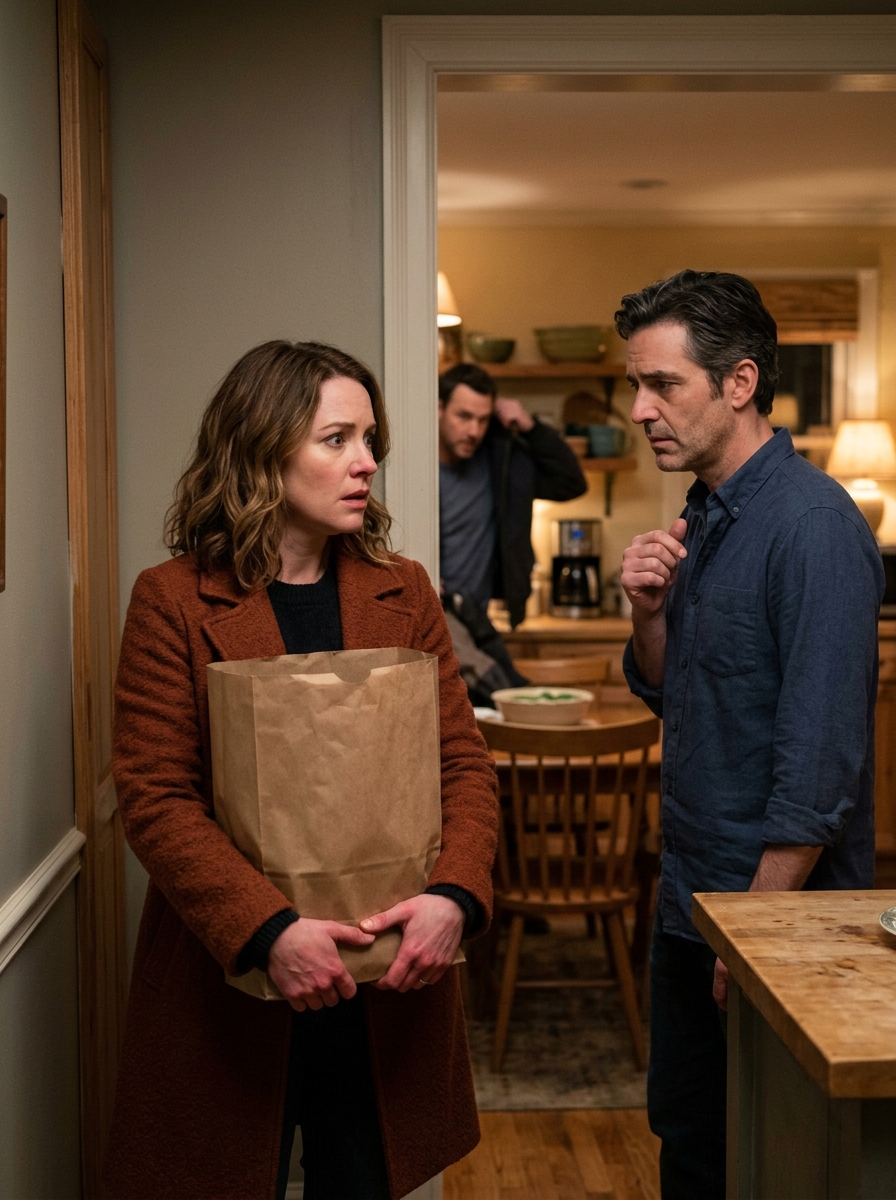
Nora kept hold of the grocery bag. A lime rolled against a carton of eggs. She could feel the thin plastic stretching beneath the weight, could see the damp ring of condensation beneath Mateo’s abandoned glass.
Simon was forty-one. He had been her husband for eleven years. He was a science teacher who could explain the migration patterns of monarch butterflies with the solemnity of a priest and who still called every automated customer-service line “a hostage situation.” He had a narrow face, dark hair beginning to silver at the temples, and a habit of pressing his thumb against the side of his index finger when he was trying not to say something.
He was doing it now.
Nora set the bag on the floor.
“Are you telling me you’re gay?”
“No.”
“Are you telling me you’ve been having an affair?”
“No.”
“Are you telling me you don’t love me?”
His thumb stopped moving.
“No,” he said. “I’m telling you that I don’t experience sexual attraction the way you do. Maybe not the way most people do. I don’t know if asexual is the exact word, but it’s the first one that hasn’t made me feel like I’m a defective husband.”
Nora stared at him.
The refrigerator hummed behind her. Somewhere in the living room, the old clock clicked forward one second at a time.
“You said our bedroom was dead.”
“I know.”
“You said it to Mateo.”
“I know.”
“You’ve known this for two years?”
Simon looked down.
“That’s not an answer.”
“About two years,” he said. “Maybe a little longer.”
Nora laughed once, sharply. It sounded nothing like amusement.
“And I’ve known for four minutes.”
“I didn’t plan for you to find out this way.”
“No, apparently you planned for me not to find out at all.”
“That isn’t fair.”
Her head turned toward him.
“Don’t use fair with me tonight.”
Simon flinched—not dramatically, not as though she had struck him. He simply absorbed the words and looked older.
Mateo had been his closest friend since college. He had been in their wedding. He had helped Simon move Nora’s grandmother’s piano into the house, a process that had involved three rented dollies, a cracked banister, and one spectacular argument about whether physics could be negotiated with enough optimism.
Mateo knew things about Simon.
Nora had always accepted that.
She had not known Mateo knew this.
“When did you tell him?” she asked.
“Three weeks ago.”
“Three weeks.”
“Nora—”
“You had three weeks to get used to the sentence. Three weeks to say it out loud. Three weeks to decide whether it changed anything. And I had to hear it through a kitchen wall.”
“I wasn’t deciding what it changed. I was trying to understand what it meant.”
“For you.”
“For both of us.”
She looked at him then, really looked. Simon’s shirt was wrinkled from the day. There was a pale streak of paint on his wrist from helping Mateo repair the downstairs window frame. His wedding ring caught the light when he lifted one hand.
She had loved that hand for years.
She had also spent the last two years wondering why it so rarely reached for her.
***
Mateo sent her a message the next morning.
I’m sorry. I should have left sooner.
Nora read it while standing in the kitchen, her coffee cooling between her palms. She did not answer.
Simon had slept in the guest room. They had never used the guest room for this. It had been a place for visiting cousins, a temporary office during a plumbing repair, and once, during a summer heat wave, a refuge for the dog they had fostered for nine days before admitting they were not dog people.
At six-thirty, she heard Simon move around in there.
At seven, the kettle clicked on.
At seven-ten, he knocked on the bedroom door.
“Can I come in?”
Nora was sitting against the headboard, still wearing the clothes she had fallen asleep in.
“Yes.”
He opened the door but did not cross the threshold.
“I made coffee.”
“I can see that.”
“I didn’t know if you wanted some.”
“I don’t know what I want.”
He nodded. “I understand.”
“No, you don’t.”
He accepted that, too.
There was something infuriating about how quickly Simon had become reasonable. Nora wanted him to defend himself badly enough that she could hate him cleanly. She wanted anger, denial, some proof that he had been careless rather than afraid.
Instead, he stood there with his hands at his sides, prepared to be punished by a truth he had delayed telling.
“Would you have told me?” she asked.
“Yes.”
“When?”
He hesitated.
“That isn’t an answer either.”
“I had made an appointment with a couples counselor.”
“When?”
“Next Thursday.”
Nora looked at the calendar on her nightstand. The next Thursday was six days away.
“You were going to tell me next Thursday?”
“I was going to ask you to come with me.”
“After two years.”
“I know.”
“Stop saying that.”
His mouth tightened.
“Okay.”
She swung her legs over the side of the bed. “I need you to explain what you mean when you say you’re asexual.”
“I’m still figuring that out.”
“That is not a small thing to be figuring out after eleven years of marriage.”
“I know.”
She gave him a look.
“Sorry.”
He leaned against the doorframe.
“I don’t mean that I don’t love you. I don’t mean I’ve been pretending every time we’ve been close. I don’t mean I never liked being touched or that our entire marriage was some kind of performance.”
“What does it mean, then?”
“It means I don’t feel that pull. The… wanting. Not consistently. Maybe not at all.”
Nora’s throat tightened.
“You wanted me when we met.”
“I wanted to be near you.”
“That’s not the same thing.”
“I know that now.”
The sentence struck her as cruel, though he had not said it cruelly.
“What do you mean, now?”
Simon looked past her, toward the window and the gray morning beyond it.
“I thought everyone was translating. I thought desire was mostly deciding that someone mattered and then doing the things people did when they loved each other. I liked kissing you. I liked being close. I liked knowing you wanted me. Sometimes my body followed the rest of it. Sometimes it didn’t. I assumed that was just stress or age or being married for a long time.”
“And two years ago?”
“Two years ago I stopped being able to pretend I didn’t notice the difference.”
Nora remembered that year with painful clarity.
She had turned thirty-six. Simon had started teaching an extra class after a colleague took medical leave. Her mother had broken her wrist, and Nora had spent six weeks driving across town to take her to appointments. Nothing dramatic had happened between them. There had been no betrayal, no explosive argument, no single night that divided their life into before and after.

More From This Author